
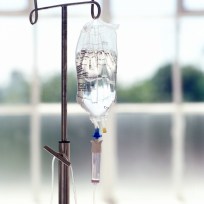
Infliximab
Since my first signs of a flare in May 2013, my Crohn’s hadn’t been under control. It was now the 21st April 2014, and after struggling for over a year on steroids and antibiotics with little success, I was admitted to hospital again for investigations. It was supposed to be just the usual abdominal MRI and colonoscopy, but after my temperature soared post-procedures, the doctors feared that they had nicked me during my scope and caused an infection. So, what I expected to be a couple of days in hospital turned into over a week of IV antibiotics. Luckily, my temperature soon settled down, but the results of my tests were increasingly worrying. It was then decided that my only option was Infliximab, an anti-TNF biological drug that is supposed to keep the immune system from attacking the body. I was told that I would be given a “loading dose” whilst in hospital (a large starting dose) and then a follow-up maintenance dose every 8 weeks for the foreseeable future. Given my limited options and my complete trust in my doctors, I agreed and on the 30th April 2014 I had my first dose.
I’m not going to lie, I didn’t think I was nervous until I sat down on my hospital bed, the canula in my arm and the infusion hooked up in front of me. I just cried. Suddenly it became real. This was my life. But even though this medicine was a complete unknown to me, I knew I needed it. And sure enough, once the drip was connected, I calmed down. It felt so strange going into my veins, almost like I was drinking an energy drink! I felt hopeful, this had to work.
And it did! After a few weeks alone I had my zest for life back. My appetite returned and I went from spending most of day in the bathroom to only needing one trip a day! It felt like a miracle and I couldn’t wait to go back for my next dose. But after my second trip to London and my third, I did experience some unwelcome side effects. The “energy drink-like” feeling I had on first receiving the drug morphed into an excruciating and constant stomach pain which lasted for several days after the infusion. I couldn’t sleep through the agony and spent the first few nights after every hospital visit lying with a hot water bottle on the downstairs sofa watching re-runs of old tv shows through the night. But after these few days, the drug really kicked in, so I thought it was worth it. This was the best I’d felt since being diagnosed.
Double dose and mercaptopurine
But come September 2014, only 5 months after starting infliximab, slowly the seemingly miraculous effects of the drug began to wear off. Instead of feeling down for a few days after the infusion and then feeling well for 8 whole weeks until the next one, I could feel around the 5-6 weeks point that the impact of the drug was beginning to fade, and my symptoms came back. It was like my system could no longer wait 8 weeks for a top up. But at the time, unlike some other drugs, I was told that infliximab couldn’t be given every 6 weeks instead of 8. The only solution was to double the dose. And in December, that’s what we did. In the new year I began to feel a lot better again and my symptoms were better controlled on the higher dose, with frequent blood tests monitoring my drug levels. But my IBD team felt that the drug needed extra support from an immunomodulator, and despite my previously tricky relationship with azathioprine, they decided to start me on mercaptopurine (6MP). I must say, I didn’t really feel any physical benefit after starting 6MP, but I was reassured that it may take a while to get into my system and I would have to be patient to see results. But at this point, I was back at school and getting good grades, hanging out with my friends and enjoying a balanced diet, so I wasn’t complaining.
Erythema
The only real issue I was having, other than some mild, patchy symptoms here and there, was my erythema. The infliximab had definitely helped my mobility and seemed to soothe both my erythema and my joint pain. Nonetheless, my body’s inadequate immune system meant healing was always slow. My legs were still scarred all over; bluey red patches were everywhere and I still needed exemption letters- not just from taking part in P.E, but from being asked to change into my P.E shorts even though I wasn’t participating (whoever came up with that pointless rule anyway?!) This soon led to some suspicion on my teacher’s part. At the time, barely anyone knew about my health problems, only my closest friends and senior staff. So one day when I approached my P.E coach in the changing room with my weekly letter as I had been for months, she outright asked me: “Do you know why you aren’t allowed to change into your P.E kit?”… I thought, well duh. “Yes, I do”, I replied. “So, how are things at home? Do you have a good relationship with your parents?” Where on earth was this going. In actual fact, it seemed that from the “extensive bruising and marking” to which my letters referred, my P.E teacher thought that I was being abused at home. Just one more thing to deal with! But not to worry, my mum was ever so quick to deliver some strong words to my teacher for even suggesting that she could, or would, harm her own child. And soon I was back to wearing my normal school uniform and taking the scores on the field undisturbed.
Infections
My happiness was only ever so slightly tainted when my regular blood tests began to show up positive for several infections. At first it didn’t seem like a big deal; we already knew that my immune system was weak and that was just something I’d have to deal with. But soon I was getting all manner of verrucas, warts, shingles- you name it! These seemed rather trivial at the time, my naïve younger self just thought I’d much rather have those problems and feel reasonable than the other way around! But one of my gastroenterologists then explained to me that these infections were only the beginning, and they were visual manifestations of the fact that my immune system was worryingly powerless. They decided that the best thing to do would be to stop the mercaptopurine for the time being and, without my knowledge, drop back down to the normal maintenance dose of infliximab. I am still not sure why they decided not to tell me about the latter decision. I still question whether or not that was ethical; I had recently moved from paediatrics to the adult clinic, but my IBD doctors still had full control of health-related decision making. Perhaps they thought that by not telling me, it may have a kind of placebo effect and psychologically I would still feel confident in the effectiveness of the double dose? I’ll never know.
For a while I was managing on that dose anyway, despite some patchy symptoms. And in the summer of 2017 I got the news I had waited years for- I had gotten a place at my first choice of university. I was absolutely thrilled and couldn’t wait to start a new chapter in my life. I was determined not to let my health get in the way of my dreams.
“I finally decided on the right course for me- English and French, a four year course with… wait for it… a year abroad! I know right- that sounds way too impractical/ spontaneous/ scary for me (mainly due to my health), but I have also learnt not to let that govern what I want to do.” – My journal, 18th August 2017
Other than some initial shyness, from September to December 2017 I was really thriving in my new life at university. I loved my course and the freedom of living by myself after so many years of being cooped up unwell in my bedroom at home, and I had made some great friends. But after Christmas my symptoms began to creep back again. And it soon became clear why. It may have been the constant drug dose changes, or it may just have been inevitable, but I had developed antibodies to infliximab.
Antibodies
For anyone who doesn’t know, the body can become resistant to biological drugs with time. Although my drug levels were normal in the new year (which meant that there was enough infliximab in my body to work, in theory), my antibody levels were sky high (which negated the high drug level and prevented it from having any affect at all). My consultants decided to try and double the dose (again, yawn) to try and overcome this developing resistance, as I was told that some other patients had responded in this instance.
I just about managed on this dose until about February, but despite my denial and determination to carry on with my new life, I was really struggling. I was missing numerous classes, retreating to my room rather than socialising and barely eating anything. I had to rely on my new friends to bring me things from the kitchen and collect work for me from seminars. They had no idea what I was going through and assumed it would pass. But by March, I think it was probably clear to everyone that I couldn’t go on. I felt worse than I had in a long time and after discussing everything with my personal tutor, it was decided that I wouldn’t be able to return to university after Easter for my last term. I was absolutely crushed, my first year of university had been ruined by my health as so many other things had before. And in April, I got the news I’d been expecting for a while: the dose escalation had not worked, infliximab was failing. So, after Easter I was at home, miserable about having to leave my degree and my friends at university behind for the time being, feeling physically terrible yet again and seeking another new treatment.
Looking back
Don’t get me wrong, I was eternally grateful for infliximab. And despite the fact that I became resistant to it, I still am. After all, it may not have worked for as long as I’d hoped, but it did get me through my A levels and during that period I felt better than I had in a long time. But the experience of becoming resistant to a drug was a real wake up call. It proved that you can never be too comfortable. Even if something seems to be working, it won’t last forever. I don’t mean to sound depressing though, it really made me aware of how much of a role my health would always play in my life and it was at this point that I really started to educate myself about my condition. Whilst it’s true that sometimes you can potentially know a little too much and this can freak you out, its important to have a good grounding in the treatments you’re taking- it’s your body after all!
In my research I also found out that Infliximab was only first licenced in America in 1998, just one year before I was born! I thought this was totally shocking, and for the first time I realised that I was neck and neck with medical research into Crohn’s. That was a scary thing, realising that one day I may nudge ahead and reach the end of the treatment ladder. From that point on, I was determined to make the absolute most of the times when I felt good.
“I have started a new medication – 6MP… hoping it works as I am becoming increasingly concerned that we are quickly approaching the out of options stage, which scares me.
” – My journal, 24th January 2015
But, at the risk of sounding contradictory, my time on infliximab also gave me hope in a strange way. The initial effectiveness of infliximab was astounding to me. I came to the realisation that for a long time I had been living daily with a lot of symptoms and accepting them as my “normal”, when in actual fact I could feel a lot better than that. After several years of questioning if feeling averagely symptomatic was as good as it was going to get for me, infliximab made me realise that, although I may never feel perfect, I could feel better than “okay” or “just about coping”.
Everyone reacts differently to different treatments, but don’t be disheartened if you haven’t found one that makes you feel as good as you’d like, it may just take a little time to find it. My point is, there is a spectrum of a drug’s effectiveness- it isn’t simply “is it failing or working?” If you’re having a rough time with treatments, or if a treatment is working but you still don’t feel amazing, don’t assume that’s as good as it gets. Through the bad times try and look forward to feeling better and in periods of remission, make the most of your health and remind yourself of how good you can feel, despite having a chronic illness.
 Me and My Crohn's