
Meal planning has become somewhat of a trend recently among bloggers and YouTubers alike, and it’s not that surprising why. But, as someone with Crohn’s disease, I find the benefits of planning my meals extend beyond the typical advantages outlined by those in the public eye.
How do I go about meal planning?
Firstly, let’s just distinguish between meal planning and meal prepping. The latter is where you do the preparation for all the meals you will eat the following week/ month in advance and keep them stored and ready to cook. The former, and the one this article will focus on is, as the name suggests, where you know in advance what you’re going to eat and shop accordingly beforehand rather than spontaneously deciding on that day.
Since going to university in 2017, I have been planning my main evening meals. I started with a simple digital grocery list using OneNote so I could see all the possible foods I may be buying each week. Then, I compiled a list of all the dinner recipes that I’d tried and tested for my Crohn’s before doing the fun part: making my meal plan. My terms at university lasted 10 weeks, so logically I decided on a 10-week meal plan which would be repeated each term.
Now, there are a few things to think about before creating your meal plan. Firstly, you need to consider which day of the week you are going to do your shopping so that you can use up the produce which spoils quickly in the early days after your shop. For me, grocery day was a Saturday, so I knew I should probably put the meals with the freshest produce as close to Saturday as possible, leaving more store-cupboard based meals like pasta for the end of the week.
You also need to think about portion sizes. If like me you are cooking for one, obviously it would be silly to buy a large quantity of something fresh, only use a small amount and end up throwing the rest away. To combat this, try and put certain meals close together where you can use up left-over produce before it goes off. And of course, make notes about which foods you can freeze or buy frozen. Luckily, more supermarkets are now selling vegetables and fruit which never used to be available frozen like kale or spinach- I can never finish a full bag on my own in a matter of days, so buying it frozen stops it being wasted.
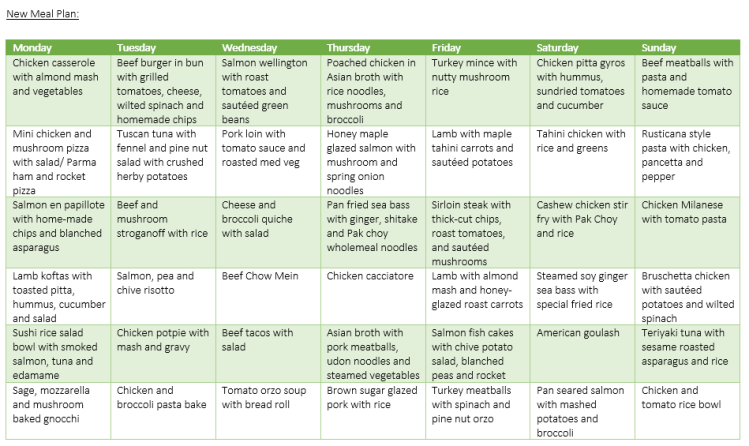
Finally, you should consider how balanced each week of meals is. For example, it wouldn’t be ideal to have one week where you eat 5 portions of oily fish and then another where you don’t eat any; it’s important to try and keep your weeks mixed in terms of which produce you are consuming. Now it’s just a question of filling in the chart! Colour co-ordinating can be helpful to make it clear which protein or core-ingredient each meal consists of, that way it’s easier to keep the meal plan balanced. You could also put a slightly customizable dish like fried rice or soup towards the end of the week so that you have the opportunity to use up any remaining produce before your next shop.
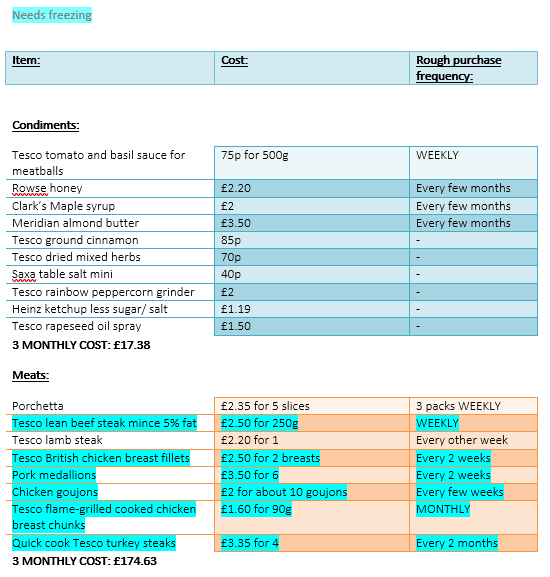
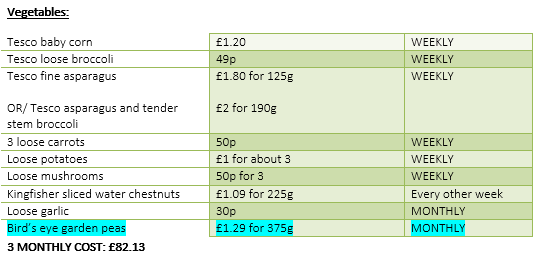
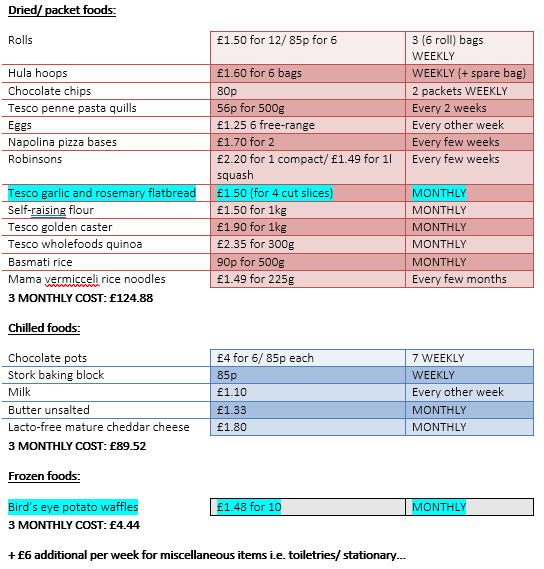
Once you have this basic meal plan, if you want to track your spending I would advise making a quick spreadsheet or a chart on Word. It doesn’t need to be overly complicated, it just needs to state how often you need to buy each food on your grocery list and how much it will cost you in a month, that way you can track your eating and finances all in one!
So, what are the benefits of meal planning?
1. It saves time and stress
The most obvious advantage of meal planning is that it saves you so much time. Not only does it make shopping easier as you know exactly which ingredients you need to buy each week and in what amount, but also it avoids the stressful “what on earth am I going to have for dinner tonight” procrastination which may otherwise take up your time. This can be a real lifesaver for people with IBD who can’t always easily go out and buy something for dinner at the last minute or use pre-made meals from a supermarket due to their dietary restrictions. Meal planning ensures that you’re always prepared for the meal you want. There’s little risk of you running out of ingredients or forgetting to buy or defrost them, all you have to do is quickly look at the chart each night and move whatever protein that needs defrosting from the freezer to the fridge so that it’s ready when you are the next night.
2. It saves money
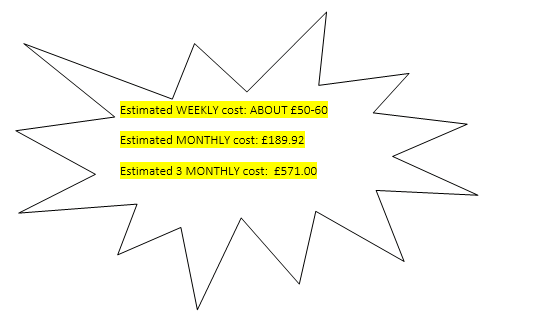
With a set shopping list and a pre-made meal plan, it’s way easier to budget effectively as you’re less likely to overspend or get distracted in the supermarket by something you really don’t want or need (because you know, we’ve all been there…). After establishing a shopping list and meal plan, I created a quick table which outlined how often I would need to buy each food/ ingredient and the cost. This meant that I could easily work out how much money I would have to spend each month on food which, as a student shopping on a budget, I found really useful as I was still able to get good quality produce and maintain a balanced diet but I was less likely to over-buy. Taking a little time to really think about your food also means that you have the chance to shop around and find the best possible deals, which will also save you some pounds.
3. It reduces food waste and benefits the environment
As I said above, if you plan your meals based on which foods are going to expire first, you are more likely to use up what you bought and less likely to end up binning fresh produce because it’s gone off. The same applies to portioning; if you already know how much of each food you need for a week/ month, you will only buy that amount and no more, meaning that you aren’t left with any unwanted or excess produce. Anyone who lives alone knows how challenging it can be food shopping for one as you can only buy certain foods in bulk i.e. eggs, bread and freshly packed vegetables like leafy greens or salad.
If you have flatmates, it may be a good idea to suggest sharing these things to reduce waste more. Otherwise, just try your best to incorporate as much as you can into your meal plan or research suitable alternatives which are more sustainable and economical. For example, instead of buying a fresh loaf of bread which you know you cannot finish within a few days, buy part-baked rolls which can be stored for a month or two. Or alternatively, find uses for whatever is going stale. I tend to turn going-off pitta bread into pitta chips and use excess puff-pastry from my chicken pot pie for snacks like cheese twists. Planning ahead means you’re more likely to solve these waste-related problems rather than mindlessly wondering round the grocery store picking up whatever looks good and not really knowing what you’ve got in the back of your fridge or cupboard at home.
4. You are more likely to eat healthier and get the correct nutrients
Various studies have shown that thinking up your meals ahead of time is a great way to eat healthier as you are less likely to buy unhealthy or fast food on the quick because of laziness or lack of planning. If you pencil in a salad and buy the ingredients, you are incentivised to make what you initially sought to which means you can create and maintain a healthy diet much more easily. It’s all about routine, which is key in keeping up a healthy lifestyle.
What’s more, for patients with health issues meal planning can also be a good way to ensure that your body is getting exactly what it needs. I for example suffer from iron-deficiency anaemia and by planning my meals, I can make sure that I am eating enough iron-rich foods like spinach, red meat or chickpeas. Likewise, once I’ve got my ileostomy (which I will be getting in less than 2 weeks now!), I can ensure that I am eating the correct amount of potassium and sodium over the course of my week, therefore replacing the minerals which will be lost through my ostomy.
5. For IBD patients it can help balance your symptoms
IBD patients in particular may also benefit from meal planning because of the consistency and routine it gives to their digestive system. Though it hasn’t really been scientifically tested, I personally have found that by planning my meals, my digestion runs much more smoothly as my stomach knows what to expect, as it were. For example, if I always have chicken on Monday, a vegetarian dish on Tuesday and a salmon dish on Wednesday etc., then my body gets used to that rhythm and gets consistent nutrients week-in, week-out.
Perhaps it’s just psychological, but it definitely makes me feel more in control of my body and my symptoms. I know if I were to end up eating oily fish on 2 or 3 consecutive days for example then my system would become a little off balance- and no one wants that especially if it can be avoided. Meal planning is therefore a great way to establish a “digestive regime” of sorts and this has really helped me with managing my disease symptoms. It also means that if I start to notice a pattern of symptoms over a number of weeks or I feel rough on certain days, then I can easily identify what has caused it by examining my meal plan.
So, there you have it! If you want to make your diet healthier, more consistent and more environmentally friendly, then meal planning is 100% the way forward. It may take you a little while to set up your plan, but once you have it, you’ll never look back! And if you continue to try new foods or recipes, you can always adapt your plan as you go along- its all about having a plan that’s completely your own and that suits your diet and lifestyle. Below are a couple of examples of my previous meal plans and budgeting sheets to help you get started if you want to start planning your meals.
 Me and My Crohn's