
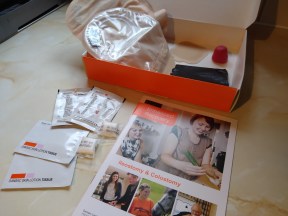
If you’ve been reading my previous posts, you will know that I am about to have surgery to remove my entire colon and get a permanent ileostomy. In preparation, I attended a stoma nurse clinic where I was given an unexpected tool to help me prepare for waking up from surgery: a practice stoma kit. In all my research I had not come across this, so I was weirdly excited to put it to the test. For 24 hours I wore a fake stoma and an ostomy bag to give myself a taste of life post-surgery and I can now humbly give you my account of the process.
What are the benefits of doing a trial run like this?
- You can familiarise yourself with the equipment
- You can practice the processes of putting on, emptying and removing an ostomy bag
- You can get a feel for having the bag on and how you may have to adapt your daily life
- You can try different bags and get an idea of which style you might prefer
- You can gain some reassurance and an understanding of what to expect which will make you less shocked and anxious when you wake up from surgery
How does the experiment work?
I was given this kit from my stoma nurse and it contained the following items: 3 ostomy bags, a foam “stoma”, a sticky base for the stoma to stick to, some reactive salts, skin lotion wipes, adhesive remover wipes and a disposable bag for waste. The idea is that you estimate where your stoma might go, attach the fake stoma and wear a bag around the house for a day or so to see how it feels. The part I was particularly impressed by however was the salts. They are designed to react with water and form a jelly-like substance which is roughly the consistency of ileostomy output. By using these, you not only get to experience the sensation of having the ostomy bag attached to your abdomen, but you also get an idea of how heavy and large the bag can become at full capacity. So, where to begin?
First of all, I had to choose which bag to wear for my little trial run. There were three types provided by my stoma nurse; a clear drainable one-piece, a drainable one-piece with a window and a closed opaque two-piece. For those of you who are unfamiliar with ostomy bags, drainable bags allow you to empty the contents of the bag without having to constantly change it, unlike the closed bags which require completely replacing when the bag becomes full. For this reason, I figured that a drainable bag would be the most practical. As for the difference between a one-piece bag and a two-piece, a two-piece has a separate base plate (the part that sticks to your skin) and bag component, whilst a one-piece fuses these two components together. The function is therefore the same, but the practical difference is that with the one-piece, everything has to be completely changed every 1-2 days, whereas the two-piece allows you to leave the base plate attached for 3-4 days and snap on a new bag when necessary. I was told that I would probably wake up with a clear one-piece bag in hospital as it is the easiest way for the nurses to monitor my new stoma and it won’t put the same pressure on my stomach as the two-piece which requires you to snap the new bag onto the base plate with a little more force. For this reason, I decided that the clear drainable one-piece would be the best test subject.
Phase 1: Putting the bag on
So, first things first, I needed to attach everything! I started by taking a look at my stomach and deciding where best to place the bag. As my stoma will be an ileostomy, it is likely that it will be on the lower right portion of my abdomen, so I chose a site around half-way between my bellybutton and my hip. I then peeled off the adhesive backing on the stoma base and placed it on my chosen location. Next, I removed the adhesive backing (you’ll notice there will be a lot of this going on!) of the fake stoma and stuck it in the middle of the stoma base on my stomach. Now for the fun part! I tipped one sachet of reactive salts into my chosen bag through the stoma opening and added about 150ml of cold water as noted in the instructions. It very rapidly turned into the porridge consistency that I will eventually expect from my stoma. The hole in the stoma bag was already cut to the size of the fake stoma, so not cutting was required. I just removed the adhesive backing (for the last time I promise) of the stoma bag and attached it firmly around my stoma.
Phase 2: First impressions
I must say, my first thoughts were that the bag was nowhere near as heavy as I was expecting. I mean, I don’t really know what I was expecting to be honest, but I feared that I would feel a little weighed down by a near full capacity bag. So, it was a pleasant surprise to find that the bag was fairly manageable in terms of weight. As far as position was concerned, the bag sat quite nicely and I was able to tuck it into my underwear with little discomfort or itchiness- which was a concern I had, I can’t deal with chaffing all day every day! I am aware that stomas change in size a fair bit and that for the first few months after surgery it will be rather large and bulgy, but I do think that the fake stoma provided did protrude quite a way out. I am hopeful that once my stoma has calmed down, it won’t stick out quite so far.
Phase 3: Clothing
So, with the attachment done, the next stage of my experiment was to try on some of my clothes and see how they looked and felt with the stoma bag. I always read that high-waisted bottoms are the way to go when you have an ostomy, so I started with my favourite high-waisted jeans. I must admit, the bag did bulge slightly as it was filled to about 2/3 capacity. But, it did feel nice and secure and the top of my jeans were at the perfect height to sit just above the top of the bag without squashing it. The main thing that was noticeable was the protruding stoma itself, but as I said above, I think the model was based on a new stoma which would eventually reduce in size slightly. But to be honest, I don’t usually wear cropped or tight fitting tops anyway due to issues with bloating (who knows if this issue will be resolved after all my strictures are gone), so my usual camisole or split-hem jumper covered the stoma and the bag very well and I don’t think anyone who wasn’t looking for it would have noticed it at all.
Some of my skirts were a little more problematic, however. I usually go for A-line and my denim one was made rather tight to say the least because of the position of the stoma. But I am confident that if the stoma was placed a little bit lower the problem would be significantly lessened. Otherwise, I will just have to opt for my second favourite skirt style: the skater skirt. Either way, I would say that I was quite satisfied with the results of my trying-on sesh. I didn’t venture into the realm of swimwear as mine will need replacing with something more secure and high-waisted for my own peace of mind, but as for underwear, my low-waisted knickers sat just underneath the bag and prevented it from rubbing against my skin which was good. I do plan to get some specially designed underwear from a company like Vanilla Blush though, as they sell briefs with pockets for your stoma bag- how neat is that!
Phase 4: Showering
My next task was to shower with the bag on, and I was particularly interested in two things: 1) how wet the bag became, and 2) how the seal was affected by the water and condensation. Again, I was quite pleasantly surprised by the result. I do a love long shower and by long, I mean LONG i.e. between 30-40 minutes (sorry planet, but my hair needs some special attention right now…). But despite my extra long time under the water, the bag stayed put and didn’t really get any heavier, though the underside of the bag, which was made from fabric, did soak up a little wetness. You can, in fact, shower without a bag on at all, but personally I would rather not have an active stoma while I am trying to get clean. When I got out of the shower I pulled at the bag slightly to test its stickiness and, apart from a few little edges, for the most part it was still secure. I did notice that although the bag initially didn’t seem that wet, once I had gotten dressed it did seep a little onto my underwear and left an unwelcome wet patch though… Based on this, I think a good time to change the bag might be just after a shower.
Phase 5: Emptying the bag
Okay, so I very briskly realised when I went to empty the bag that the angle at which I had attached it probably wasn’t the best. Most people seem to empty their bags into the loo while sitting on the toilet, but it was obvious to me that there was no way that my bag was going to reach the toilet. So, I had to opt for position number 2 instead i.e. kneeling in front of the toilet- not as practical or sanitary for public loos I imagine… But nonetheless, once I had found a good position, I found emptying the bag quite straightforward. I just needed to undo the Velcro at the bottom of the bag’s drain, unroll the bag and gently tip the contents out. (Disclaimer: I didn’t actually empty the salts into the toilet as I wasn’t sure that this was a good idea for the environment. So instead, I tipped it into our bathroom bin in the end, I just wanted to see how emptying it into the toilet would work normally). After emptying, I simply rolled the bag back up, secured the Velcro again and carried on going about my day.
In terms of frequency, I believe the amount of times a bag needs emptying can range quite a bit from about 4-8 times a day, depending on health conditions and diet etc. That’s about the amount you might use the loo anyway (especially as ileostomates have to drink plenty of fluids), so I found the thought of that pretty manageable as well.
Phase 6: General wear
I put the bag on in the morning and wore it for the rest of that day and throughout the night. As I am still in a flare up at the moment, my day didn’t really consist of very much. But it definitely didn’t bother me when sitting in most positions, other than when I tried to sit with my left leg flat and my right leg bent upright as that did squish the bag slightly. I should also say that gas wasn’t an issue at all because the bag I used had an in-built charcoal filter to remove excess air. I would definitely recommend having a bag with this feature as it not only prevents ballooning, but also any odours accumulating in the output.
One thing I did notice myself doing, which I anticipated might happen, was checking the bag constantly to make sure that it was still secure and hadn’t leaked. I have read about this mild paranoia among other ostomates and given my naturally mildly obsessive nature, I expected to experience this once I’d had my stoma fitted. I think that this is very normal however- after all, you have just had major surgery and life with a stoma can be very different to before. I am hopeful that this mental aspect of having a stoma will settle down during my recovery.
Phase 7: Sleeping
Now comes the big question: will my sleep be affected by having a stoma? Obviously I couldn’t really address the main aspect of this, being how the stoma might interrupt your sleep due to the need to empty your bag’s contents in the middle of the night or the early hours of the morning. But, what I could test was how my nightwear and sleeping position might be affected. I decided to wear a tight-fitting vest to gently hold the bag in place and stop it from flapping about if I rolled over. This seemed to work quite well, and I felt very safe and secure when I got into bed. I do usually lie on my right side with my knees bend up to my stomach, which proved admittedly a bit of a challenge. Not in that it was overly uncomfortable, but in that I knew that if I had a real stoma and ostomy bag, I would risk potentially constricting or even bursting it because of the pressure I was putting onto it. So, I adapted my position and leant backwards a little more with some support from my duvet, which took some getting used to, but I still ended up falling asleep in good time. Likewise, I did wake up in the early hours of the morning, but I’m not convinced that this was strictly stoma experiment related as I have issues sleeping at the best of times. All in all though, I did get a reasonable night’s sleep and when I woke up in the morning, the bag was still just as firmly attached as when I got into bed, which is obviously a good sign.
Phase 8: Removing the bag
The morning afterwards, I went about the final stage of my experiment: removing the bag. To do this, I used the provided adhesive wipes and gently prized the bag away from my skin. It was at this point that I realised something I had forgotten to do: shave the area underneath. Now, I know what you’re thinking: “how hairy is this girl’s stomach?!” But trust me, even if you only have the tiniest hairs going on, it does hurt to rip quite a large area of industrial strength adhesive off. So, note to self: always remember to shave your stomach before attaching a new bag or base plate! The pack also provided some lotion wipes however which did calm my skin down afterwards and removed most of the excess stickiness. I then binned the bag and wipes in the disposable bag provided and with that came the end of my experiment!
What did I learn?
Overall, I found my little stoma trial run a really positive and beneficial experiment. Whilst I am sure that having a fake stoma is not really comparable to having a real one and I recognise that I didn’t have any stoma-related pain to contend with, the purpose is not to replicate life with a stoma exactly. Instead, it’s about breaking the ice and becoming familiar with the psychological idea of having a stoma and an ostomy bag on your body. I do feel less like they are foreign objects now and I hope that this will help me deal with the post-surgery shock and anxiety that a lot of people face. Having a day to familiarise myself with what living with a stoma may entail gave me confidence that I will be able to get through surgery and adapt my life where necessary. So, with that said, I would definitely recommend this experiment to anyone who is potentially looking at stoma surgery in the future.
 Me and My Crohn's