
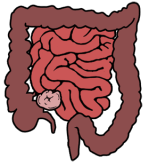
Happy New Year everyone! The eagle-eyed amongst you may have noticed that it’s been a while since I last posted, but it really has been a hectic and difficult few months. After being cancelled the first time around, I finally went in for my pan proctocolectomy (that’s a fancy word for ileostomy surgery) on October 25th 2019 and ACTUALLY got it done. Thankfully, this time I only had to wait a few hours before being called to theatre and that time was taken up by a few medical students on their placement year who wanted to interview me for their research. I’m not going to lie, its definitely a strange feeling when three other people who are exactly the same age as you look at you in awe and disbelief as you describe the entirety of your (very extensive) medical history. Although we were all twenty years old, I felt worlds apart from them. But our reminiscent chat was nonetheless cathartic for me seeing as my whole journey with Crohn’s seemed to have built up to this operation.
I eventually went down to theatre at around 10am. Here I began the pre-surgical preparations, which for me included getting an epidural fitted. For those of you who don’t know, having an epidural basically means getting a small tube inserted near the base of your spinal cord which is used to administer anaesthetic and numb the sensation of the lower half of the body, hence its use in childbirth and some major surgeries. I was a little anxious about this as I’d never had a reason to get one fitted before. The insertion of the tube, though relatively painless thanks to some cold spray, was a strange experience to say the least. The anaesthetist told me that I would need to sit doubled over with my chin pressed to my chest on the very edge of the operating table for around 20 minutes after the tube had been inserted without moving at all- a nurse was literally holding me in a head lock to steady me, otherwise the tube may not get to its correct destination. Luckily this didn’t happen and after having a couple of cannulas fitted, I was asked to lay down and was sent off to sleep.
The operation went to plan (thank goodness!) and took about 6 hours. It would probably have taken far longer if I’d had keyhole surgery, but my surgeon thought that the operation was so extensive that open surgery would be best. My surgeon’s registrar informed me that my colon and rectum had unsalvageable damage, both containing severe active inflammation and years of scar tissue as well as numerous strictures, some of them impassable. The end of my small intestine needed to be removed as well as it had a very tight 20cm stricture also. Fortunately, my stomach and the rest of my small intestine were apparently not as damaged as we initially feared. The registrar also told me that I would be starting IV antibiotics as they discovered a pretty severe infection around my rectum, which they thought likely stemmed from the abscesses and fistula which I’d been suffering from since February! They hoped that by removing the main area of infected tissue once and for all before stitching me up, it would finally be dealt with. Time would tell.
At first I was pleasantly surprised by how I felt after I woke up from surgery, the epidural initially seemed to be doing its job as I couldn’t feel much at all. Once I was a bit more “with it”, I assessed myself to get a clear picture of everything that was going on. I had cannulas in both arms- one of which had a larger arterial line, through which I was given some blood during surgery. I had a urine catheter- as I obviously wouldn’t be popping off to the toilet any time soon! I also had two drains: one was a clear plastic tube going into my abdominal cavity to draw out fluid into a bottle, the other was a lot larger and came out of my left butt cheek and into a drainage bag. The entire length of my abdominal wound was stapled and covered in a massive bandage and my ileostomy was draining into a clear stoma bag to the lower right of my abdomen. Then of course there was the blood pressure cuff, the pulse sensor, the electrodes etc. Needless to say, even if I was mobile, I wouldn’t have dreamed of moving an inch connected to all that stuff through fear of yanking something out! I would be stuck on my back in the same position with the head of the bed slightly raised and my legs slightly bent for at least a week.
Thankfully, the stoma nurses were taking complete care of my stoma and changing the stoma bag daily. I was very grateful also that my surgeons did such a fantastic job with forming the ileostomy. I had seen some photos of new stomas before and they always looked very large and a bit angry! Mine was never bigger than a two-pound coin and always looked pretty neat for a bit of intestine- if I do say so myself. If you are new to the concept of a stoma or you are uncertain about heading into surgery yourself, don’t be alarmed if your new stoma initially does look a little bigger or redder than you expected, it will settle down. Now, 10 weeks on, my stoma has shrunk to about the diameter of a once pence piece and I use a convex bag, so it doesn’t protrude too much either.
Actually, it wasn’t the stoma causing the majority of problems while I was in hospital at all. I don’t know if anyone else can relate, but whenever I’m admitted, I tend to suddenly find myself dealing with a rather random plethora of issues which seem completely irrelevant to what I’m actually there for but are actually entirely relevant after all. And I certainly had my fair share this time! It started in recovery when my right eye started to feel sore. My face was all swollen anyway, probably from the anaesthetic, so I thought nothing of it initially. But within a few hours I had gone from having a slightly red and puffy eye, to one which was so painful and watery that I couldn’t open it at all. Naturally, the recovery bay was completely understaffed so I had to wait with my eyes shut for several hours before a doctor could come and examine me. After pointlessly spraying me in the face with saline several times to no avail, one doctor finally suggested that they put some local anaesthetic on my eye, overturn my eyelid and have a closer look. As it happens, he did find a couple of rogue eyelashes in his travels around my eye socket, but after dropping some orange dye into my eye, he thought that there could also be an abrasion from the surgery. He prescribed me some eyedrops, but they couldn’t be used until the coloured dye had worn off, so until then he told me I would have to look like David Bowie.
The next random issue that emerged was one that I was completely unaware of before having surgery. Seemingly out of the blue, my left shoulder started to feel VERY painful. Luckily this was, albeit temporarily, gotten under control with a morphine injection, but I was completely naïve to the concept of “referred pain”. Apparently referred pain is not uncommon after abdominal surgeries. The culprit is the carbon dioxide used to inflate the abdomen pre-op, it irritates the diaphragm and in turn the phrenic nerve, causing a painful sensation in the shoulder. How bizarre.
Anyway, at around 3am on the 26th of October, I was finally moved out of recovery onto an actual ward, though not the one I was intended for, and the ever amusing “spray checks” began. This is basically when a nurse sprays cold fluid all up your legs and stomach asking: “can you feel that?” for about 10 minutes every couple of hours. The purpose? To see the cut-off point of patients with an epidural i.e. where on the body the numbing effect ceases. So, the nurse asks if you feel cold, wet or pressure from the spray to keep track of this. In my case, the epidural was not quite reaching high enough to numb the area of my abdomen where most of the surgery had taken place, but was working a little too well for my legs: I couldn’t feel anything and I couldn’t move them at all, they basically didn’t feel like my legs. This proved to be an issue throughout my entire hospital stay, the doctors and the pain team trying (and unfortunately failing) to find a balance between pain relief and sensation. My primary pain drug was Fentanyl and they tried lowering this, but the pain was too intense, so we resolved to keep it at 8ml/hr despite my legs. An anaesthetist also gave me the option of a bolus (a temporary burst of a higher dose of pain relief) when I needed it. This seemed to help somewhat with the pain, but apparently not with my brain. (Pardon the rhyme!) I barely remember, but according to my parents, I was barely competent, struggling to speak and very confused. Not ideal.
I spent the next day in a similarly confused manner as well as feeling generally sick and in pain. And that night I had a rather intense conversation with a couple of nurses as I pressed my call button in the early hours to ask for pain relief for my excruciating shoulder. The first nurse had absolutely no idea what I was talking about. First she confusedly asked: “You’ve had surgery on your shoulder?” To which I tried my very best to articulately describe the referred pain I was experiencing and to tell her that I’d been given morphine in recovery and was told to ask for it again if the pain came back. Then she started fiddling with my epidural- even though I tried to tell her that my epidural was completely unrelated to my shoulder and didn’t affect it at all. Then I asked her to kindly read my notes and look at what I’d been given before. After waiting in agony for at least 20 minutes, she returned claiming that I hadn’t been given anything and that I was obviously just delusional because of the drugs. I’m sorry, I may have been a little messed up in the head, but I certainly did not imagine being given morphine and having the situation explained to me by the anaesthetist. Eventually, this particular nurse called in another male nurse, but he similarly ignored me and said that I was just confused about what I’d been given.
By now it was so late and I was in so much pain that I was basically in tears pleading with someone to listen to me. (Don’t judge me, I was tired, in agonising pain and emotional after having the biggest surgery of my life. Plus, who wouldn’t be frustrated when they know full well what has happened despite being dosed up on pain relief, and yet someone else is trying to convince them that they are delusional!) I was then told that they needed to move me- that is, despite my surgeon’s specific instructions to keep me still, and they then proceeded to yank me up the bed, almost completely dislodging my urine catheter and making my pain 10 times worse. After this incident, I concluded that they clearly weren’t going to help me, so I just told them to forget the whole thing because now the stress of trying to explain myself to them was keeping me awake. So, with that, they left me in pain (and in tears) in the dark of my room. Right about now I was wondering what on earth I’d got myself into.
Generally speaking, strong pain killers can make you feel pretty grim and I have learnt over the last few months that they definitely don’t work that well for me- you will read all about this in good time. Whether they cause unbearable side effects or just don’t work at all, they are definitely not my favourites. And later that night I began to experience a whole new side effect which I really did NOT appreciate. My slight confusion, or should I say my “dazed” state, turned into some quite severe hallucinations. I remember lying in bed in the darkness genuinely not knowing what was real and what wasn’t. I kept having conversations with a nurse aloud in my room, but I knew deep down that something wasn’t quite right. One minute I was completely engrossed in the scenario, the next minute I would instinctively close my eyes and open them again to find that I was imagining the whole thing. It was as though I was weirdly conscious of the fact that I was hallucinating, but still I felt completely out of control. Soon, with the help of the anaesthetist, this subsided enough to make me competent again, but my state of mind became a real struggle over the next few days because of the constant changing of such potent medications. But, since we’re on the subject, when the anaesthetist visited me again that day she did in fact confirm that I had been given morphine for my shoulder and it was written on my chart after all. I still had some functioning brain cells then. Just saying…
![IMG_20191030_110007[1]](https://meandmycrohns.health.blog/wp-content/uploads/2020/01/img_20191030_1100071-e1578327717505.jpg?w=435&h=298)
 Me and My Crohn's