
Being admitted for treatment
So, after getting my Crohn’s diagnosis in December 2011, I returned to hospital in January 2012 to begin treatment and it honestly couldn’t have come soon enough. I know I wanted to postpone starting the liquid diet until after Christmas, and I certainly enjoyed my roast turkey with all the trimmings, but my symptoms escalated to an alarming degree over the holidays. Not only was I still constantly vomiting, going to the bathroom north of 15 times a day and experiencing major stomach cramps, I now had developed a strange “rash” on my legs, arms and abdomen. My mum took me to the GP but naturally they had absolutely no idea what it was, to such an extent that the doctor actually asked me if he could take some pictures for their medical encyclopaedia as he had never seen anything like it. I’m apparently now a medical model and pioneer. Yay. This “rash” then developed from large red patches into an excruciatingly painful burden. I couldn’t walk at all, so I obviously couldn’t take the stairs at home. I stayed glued to the sofa in our living room and my dad had to use a wheelie bin carrier (yes, you read that right) just to hoist me to the toilet and back. It sounds rather comedic now I grant you, but at the time it was no laughing matter.
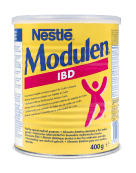
I was admitted as an emergency on 4th January and they provided me with a wheelchair to get around the hospital for scans and tests (thank goodness!). I can’t even begin to explain the pain of what was eventually diagnosed as erythema nodosum. It felt like my limbs were burning alive. Even a slight brush of my leg and I was in agony. Not to mention the sky-high temperature that came with it. I barely remember that hospital stay as I was so delirious for most of the time. But I do remember laying in bed with my mum by my side watching Despicable Me on a portable television while I had my first try of Modulen. If you are unfamiliar with Modulen, it is one of many brands of liquid diet. It is a whole-protein powdered formulation which is mixed with water to give your body all the nutrients it needs, without the aggravation of having to digest food.
The nurse initially brought me some little “shots” of different flavours to try, the least offensive of which I found to be strawberry. I mean, let’s not sugar coat it, it’s medicinal powder in water masquerading as a “milkshake” because they mix it with some Nesquik in order to try and make it taste less disgusting. I quickly discovered that not only the flavour, but also the amount would be a real challenge. Initially I had to drink 9 pint glasses a day at certain times (meaning I had to be woken up at 6am and forced to drink the first dose) and I felt constantly nauseous and extremely bloated from all that fluid. But after 3 days in hospital, they agreed that I was ready to go it alone and I was discharged on January 7th with some Modulen and my first medicine: Pentasa.
No food
Ahh, food. I was always a big eater as a child, and an adventurous one at that. I knew it would be a struggle not only consuming excessive quantities of the same gross tasting drink every day for weeks on end, but also being constantly surrounded by food that I so desperately craved but couldn’t have. Honestly, you don’t realise how omnipresent food is until you can’t have it. From being out in town and passing at least 4 restaurants, 3 coffee shops and 2 supermarkets on every street, to smelling my family’s dinner cooking in the kitchen every night. Even stupid things like being bombarded with food advertising on buses, online and in magazines and scrolling through what’s on tv to find at least 6 cooking/ baking shows. I felt completely tormented and my life became an exercise in restraint. But it was paying off. I was able to return to school within a few weeks, albeit not in “good health” but I was a trooper back then! Not eating had allowed my inflamed bowel to rest and with that, my erythema began to lessen.
School
Returning to school after all this was by far one of the hardest parts. I still wasn’t particularly mobile, so my mum drove me to and from school every day and my GP wrote P.E exemption letters. I was also given a “green card” and my teachers were all told about me, which meant that I was allowed to leave lessons to go to the toilet/ medical office should I need to. But even with all this in place, it was a struggle. Firstly, because I’d been off ill for so long that people had obviously been talking about me. There were various rumours: that I had cancer, that I went on a cruise, that I was being home schooled, that I was pregnant (ridiculous given my personality and impossible given that because of my Crohn’s I was a “late bloomer”!), etc. There were generally three categories of people upon my return: 1) people who were nice and considerate and merely welcomed me back without question, 2) people who, despite barely talking to me before, suddenly had an invested interest in knowing all the ins and outs of my absence and weren’t afraid to publicly interrogate me about it, and 3) people who thought that I was a new student because they’d barely seen me all year. And then of course, there was my group of friends. There were about 5/6 of us in total, but I was closest to 3 of them so I confided in them about what had happened. They had never heard of Crohn’s either, but with some explanation, they tried their best to support me.
It wasn’t easy, however. I still looked incredibly pale and severely malnourished, which raised a lot of suspicions- not helped by the fact that I literally wasn’t eating anything. The latest rumour was then that I was anorexic. Even the rest of my friends who didn’t know about me suspected it. And I inevitably got an endless stream of questions about my “milkshakes” which looked even more conspicuous with strange lumps of white powder floating in them. I had to bring a fair few to last the school day, so I had to carry a separate “cool” bag stocked with ice blocks to keep the formula cold enough to stomach.
Then one morning I arrived at school and the worst had happened. Somehow, the rest of my friend group had “found out” what was wrong with me. It still bothers me to this day that I don’t know how, or should I say who. They maintain that they “researched” it online and “guessed”, but one of my other friends must have blabbed. I was mortified. And this was only made worse when one of them accidently knocked over one of my “milkshakes” at lunch time. A small amount spilled on her and she freaked out, shouting “Ew! Am I going to catch it now?!” Enough said.
But eventually, I got used to strange looks and people questioning me. I learned who my real friends were and how to tell other people (politely, of course) to mind their own business. Soon I was old news and people left me be. Sure, there was still the odd comment, but if everything I’d already gone through didn’t break me, then some random peoples’ opinions definitely wouldn’t get me down. I had my friends, my family and I was back at school, learning. That was enough for me. I even established a new reputation as the score keeper in P.E as I couldn’t participate, a role which I grew to enjoy and which all the non-sporty girls envied.
Re-introducing food
So, the rules. I had to drink 9 cups of Modulen for 6 weeks straight without any food. Then after 6 weeks, I could slowly reintroduce certain food groups and test for an intolerance/ trigger for my symptoms whilst still taking a reduced dose of Modulen. At week 7, I was down to 6 cups of Modulen and a new food every 2 days. At week 8, I was down to 4 cups of Modulen and a new food every 2 days still. Then at week 9, I was on 3 cups of Modulen and a new food every day. After this I had to keep at least one cup of Modulen in my diet (usually as a substitute for breakfast) to ensure that I steadily gained weight. To organise all this, I had frequent appointments with my hospital’s paediatric dietician, who gave me a list of the order in which to re-introduce different foods. And, just for fun, I’ll list the order here:
Every 2 days:
- Potato
- Lamb
- Pear
- Chicken
- Yeast
- Milk
- Pasta
- Butter
- Bread
- Egg
- Cheese
- Cabbage
- Beef
- Pork
Every day:
- Carrot
- Tomato
- Onion
- Peas
- Rice
- Sugar
- Corn
- Rye
- White fish
- Chocolate
- Orange
- Nuts
- Ham
- Fat
- Berries
- Oily fish
- Pulses
- Herbs
- Spices
- Banana
- Apple
- Grapes
Phew, take a breath! Although painstakingly long, the reintroduction process was incredibly worthwhile. Not only does it enable the body to slowly come to terms with digesting a proper diet again, it is also designed to help patients identify which foods trigger their symptoms. I guess you could say that Crohn’s patients have a love-hate relationship with food i.e. they love food, but it hates their guts (literally). Diet is therefore an essential factor in managing the condition and everyone is different. I kept a food diary and each time I added a new food, I recorded any symptoms I had. (Check out my posts on what I currently eat to find out more about my food triggers.)
“I got home and ate my first bite of food (potato) in 6 whole weeks! If I could describe the moment in one word it would be… AMAZING!/ RELIEF!”– Quote from my journal, 16th February 2012
I have never been so grateful for the most basic of foods, to remember the sensation of chewing something solid and tasting a real flavour. Boiled potato is boring you say? Far from it. The first few days of rediscovering the humble potato were absolute bliss and taught me not to take any food for granted. I realise how bizarre I probably appeared, again especially at school. I went from eating nothing at all, to appearing to have weird short-lived fetishes with the oddest of foods.
I ate nothing but boiled rice one day and tinned pear the next and gushed excitedly over how amazing plain chicken tasted. I even remember that, despite how cinemas ban all foods not purchased at the theatre, I sneaked in plain grilled lamb chops and mashed potatoes for a snack to eat while watching War Horse! What a feast! And at this point, I was in such a heavenly foody state that I didn’t take much notice of the strange stares from the other cinema goers.
After several months of rigorous experimentation, I was back to a reasonable diet- excluding the foods which triggered my symptoms, but I still remained on 1 cup of Modulen as a daily meal supplement. I felt better than I had done for a long time and I was so grateful that the Modulen kept me well until March 2013, when the signs of my first flare up started to bare their ugly head.
Looking back
Having been on a liquid diet many times now and currently on one as we speak, I still sympathise with how difficult it is. You just have to hold onto the fact that it will help your digestive system to rest. The process taught me a lot about self-control and doing what’s best for your health, even though it may not be the most pleasant. And to this day, I have such an immense appreciation for food as well as a healthy knowledge of how my body reacts to different types of food. Not only that, I appreciate my mobility when I have it.
As for school, I am proud of how I handled my reception on returning. Its not easy being looked at like you’re an alien and being questioned about your personal life by people who wouldn’t have noticed you otherwise. In fact, now I laugh at some of the conspiracy theories surrounding my absence. For all they knew I could have been a Russian spy! After all, through intense self-study at home to distract myself from the pain and sickness, I somehow managed to maintain the highest grades of my year group- much to everyone else’s annoyance and again, suspicion. “How do you do it?”, I was always asked. The honest answer is, I wanted to have something other than my illness to define me. I was distanced from my friends, deprived of doing my favourite hobbies and sports, and suddenly just became “the sick one”. I studied so hard to instead become “the smart one”, at least that was better, and I had a say in the matter. Now I realise how I wrong I was to think that way.
My illness is a part of me, that’s a fact. But its just one part. I don’t need to be just one thing. I was still me; my illness hadn’t changed that. And anyway, I think looking back that eventually a part of me secretly liked appearing so mysterious to everyone at school. I had defied all odds; I was getting the highest grades despite barely being there. It looked like I just rocked up after 4 relaxing months at home and got an A* like a boss without even trying. If only they knew. All I can say is that, although it’s a challenge going through these things when it feels like your life is on display, you are in control of who you are and how much you tell people about yourself. I chose to keep my Crohn’s to myself, at first because I was scared of judgement and being treated differently, but eventually because I decided that it was my own business and that I had the right to share however much or little I wanted. Unfortunately, you can never escape the gaze of other people, but as long as you are content, that’s what matters.
 Me and My Crohn's